
Bay County Court Records After a Jail Arrest
Every Bay County arrest creates two record trails. The first opens at the jail. When a person is arrested and brought to the Bay County Jail, staff book them in, record the booking charges, and start the custody record. The second trail is the court record. After the arrest, the Office of the State Attorney for the 14th Judicial Circuit reviews the case. A prosecutor then decides whether to file charges, what those charges should be, or whether to drop the matter. Once charges are filed, a court case opens through the Bay County Clerk. That case is the court record, and it tracks the charges, hearings, and final result.
The arrest side and the court side answer different questions. For who is in custody, the booking date, or the bond at intake, the jail is the right source, and the jail inmate records page covers the roster in detail. Booking photos are handled on the jail mugshots page. The court record is where the filed charges live. It shows the case number, the formal counts, each court event, and the disposition. Booking charges can change once a prosecutor files, so the court file is the better place to confirm what charges a person actually faces after an arrest.
How to Find Bay County Court Records After an Arrest
Formal charges and charge status show up in the Bay County Clerk case index, not on the jail roster. The Clerk's Search Court Cases & Court Docket page, run by Clerk Bill Kinsaul, offers internet access to records that are public under Florida law. From there a link reads "Accept Terms and Search All Cases" and opens the case portal. The Clerk warns that the online information is for general personal use, is not official, and should not be relied on for legal action. For arrest and booking detail instead of court status, check the jail roster.
A look at the search page makes the steps clear. The screenshot below comes from the Clerk's Search Court Cases & Court Docket page for Bay County court records.
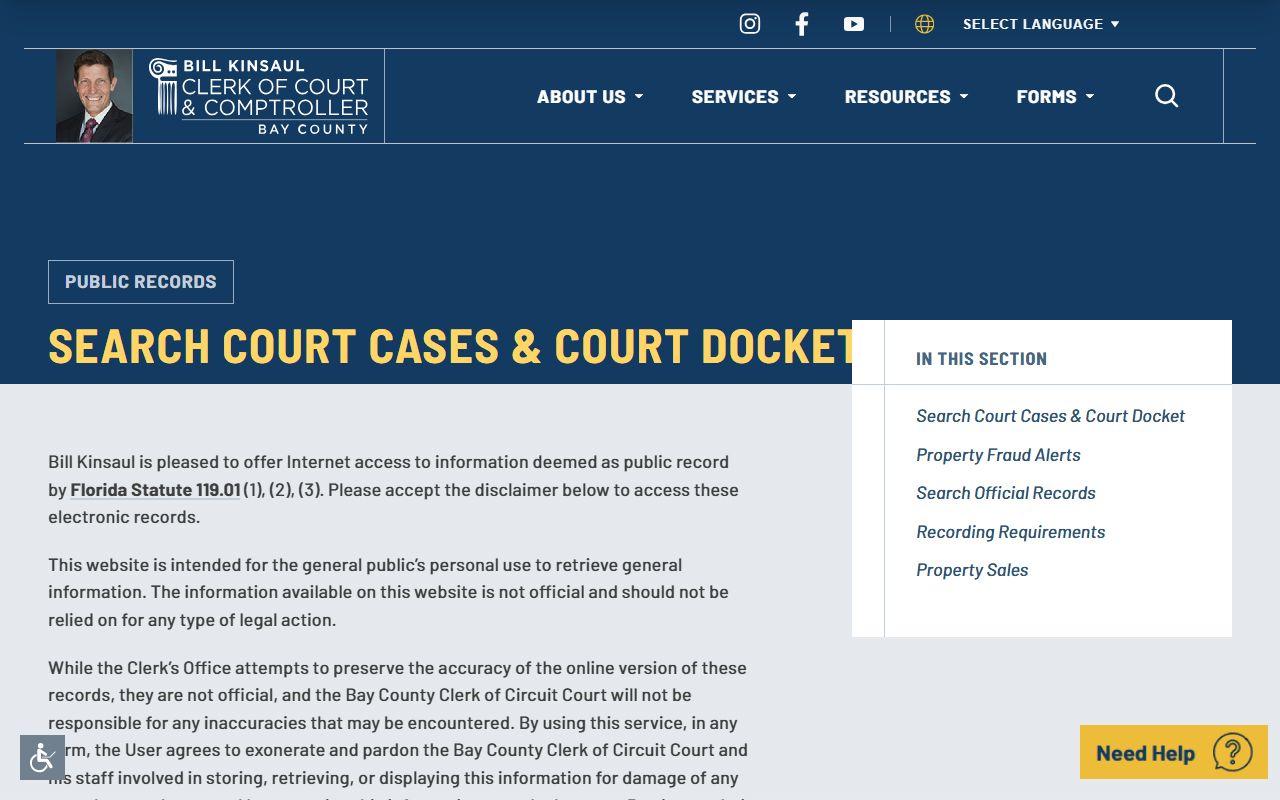
The page lays out how to enter a case number or a defendant name and how to accept the terms before a search runs. Following the steps below pulls up the charges filed after an arrest.
- Open the Bay County Clerk case portal and accept the search terms.
- Search by defendant name or by case number. Names use the format LAST, FIRST MIDDLE, and a last name alone is allowed.
- Open the matching case and read the charge list and the Events section.
- Check each charge for its code, its level, and its current status.
The portal handles the local court case. Statewide criminal-history checks run on a separate track. The Florida Department of Law Enforcement releases criminal-history information under Florida Statute 943.053, with its own access rules, fees, and limits on juvenile data. A single Bay County case can be read in the Clerk portal, but a full statewide record comes from the FDLE process, not the case-search page alone.
| Field / Method | Type | Required | Notes |
|---|---|---|---|
| Case number | Text | Optional if searching by name | Criminal example 02000034CFMA; the suffix shows the case type. |
| Name | Text | Optional if searching by case number | Format LAST, FIRST MIDDLE; last-name-only is allowed. |
| Secure login | Account access | Optional for basic search; required for broader docket features | The public, parties, and Florida attorneys apply through an Access Agreement emailed to eSupport@BayCoClerk.com. |
| Events section | Case-detail section | Not applicable | Shows court docket events for a specific case without a login. |
Case-number suffixes tell you the court track at a glance. Circuit criminal cases end in CFMA, while county criminal cases end in MMMA. Worthless-check cases end in MMMW, and criminal traffic cases end in CTMA. Municipal cases end in MOMS, and state statute or ordinance cases end in MMMO. A free secure login, set up through a Bay County Access Agreement sent to eSupport@BayCoClerk.com, opens a broader docket calendar for those who need more than a single case.
Note: The online case index is a personal-use tool that the Clerk says is not official, so confirm anything important with the Clerk's office before you act on it.
How Charges Get Filed After a Bay County Arrest
The path from arrest to court record runs in clear steps. First comes the arrest by the Bay County Sheriff's Office or another agency. The person is then transported to the Bay County Jail and booked, and the booking charge appears on the jail side. If bond has not been set, a First Appearance is held within 24 hours by a video link between the jail and the Bay County Courthouse. A judge can set bond, order no bond, or release the person. Next, the State Attorney for the 14th Judicial Circuit reviews the arrest and the evidence. A prosecutor may then file an information, proceed on the complaint, seek a grand-jury indictment, amend or reduce the counts, or dismiss or decline the case.
The charging document is the moment the court record really begins. Three main types start a criminal case. A complaint is the sworn account that an officer or prosecutor files, and it is common for lower-level matters. An information is the formal charge a prosecutor files directly, and it carries most felony cases in Florida. An indictment comes from a grand jury, which the State Attorney advises in each county of the circuit, and it is used for the most serious felonies. Once one of these is filed, the Clerk case record is the best place to track the court charges, hearings, and outcome.
The case portal makes those filed charges visible to the public. The image below is the Bay County Clerk case portal where charge records open after an arrest.
Each case in the portal lists its charges and an Events section, which is where amended or reduced counts become visible. The table sums up who files each charging document and what it usually covers.
| Complaint | Information | Indictment | |
|---|---|---|---|
| Filed By | Officer / Prosecutor | State Attorney | Grand Jury |
| Common For | Lower-level charges | Many felonies | Serious felonies |
| Starts | The case | The case | The case |
Charge Status in Bay County Court Records
Charges rarely stay still as a case moves. A prosecutor can amend a count, swap in a lesser charge, add a count, or drop one. This is why the booking charge on the jail roster can differ from the charge the State Attorney finally files in court. The arrest charge reflects what an officer recorded at intake. The filed charge is what the prosecutor chooses to pursue. The court record shows the current status of each count, so it is the place to confirm where a charge stands after an arrest.
A few status terms come up often in Bay County court records. Knowing them keeps a case file from reading like a foreign language.
| Status | What It Means |
|---|---|
| Pending | The charge or case is still open and has not reached a final result. |
| Amended / Reduced | A count was changed after filing, or a lesser offense was put in its place through a filing or plea decision. |
| Dismissed | A court or prosecutor action ended the charge with no conviction. |
| Nolle Prosequi | The prosecutor chose not to proceed on the charge, often written nolle prossed. |
Two more terms round out a Florida disposition. Adjudication withheld is a result where the court holds back a formal conviction even though penalties or conditions may still apply. A capias, also called a bench warrant, is a court order to arrest someone, often after a failure to appear or a violation of a court order. These show up in the case Events section as the case moves through the court.
Bond and Release After a Bay County Arrest
Bond is a court function, and a judge can set it at First Appearance. Some offenses carry a preset bond schedule, but any presiding judge may change it. The sheriff's Bonding Information page cites Administrative Order #2021-01-03 for preset bonds, which can be paid by cash or money order only. Money orders for bond should be made out to the Bay County Sheriff's Office. If you pay cash, bring the exact amount, because the jail facility cannot make change. A hold can still block release. Before anyone is let out, staff verify all court papers and run a background check for other charges, warrants, or detainers.
The sheriff's bonding page spells out each payment method. The screenshot below comes from the Bay County Sheriff's Office Bonding Information page and shows the official rules after an arrest.
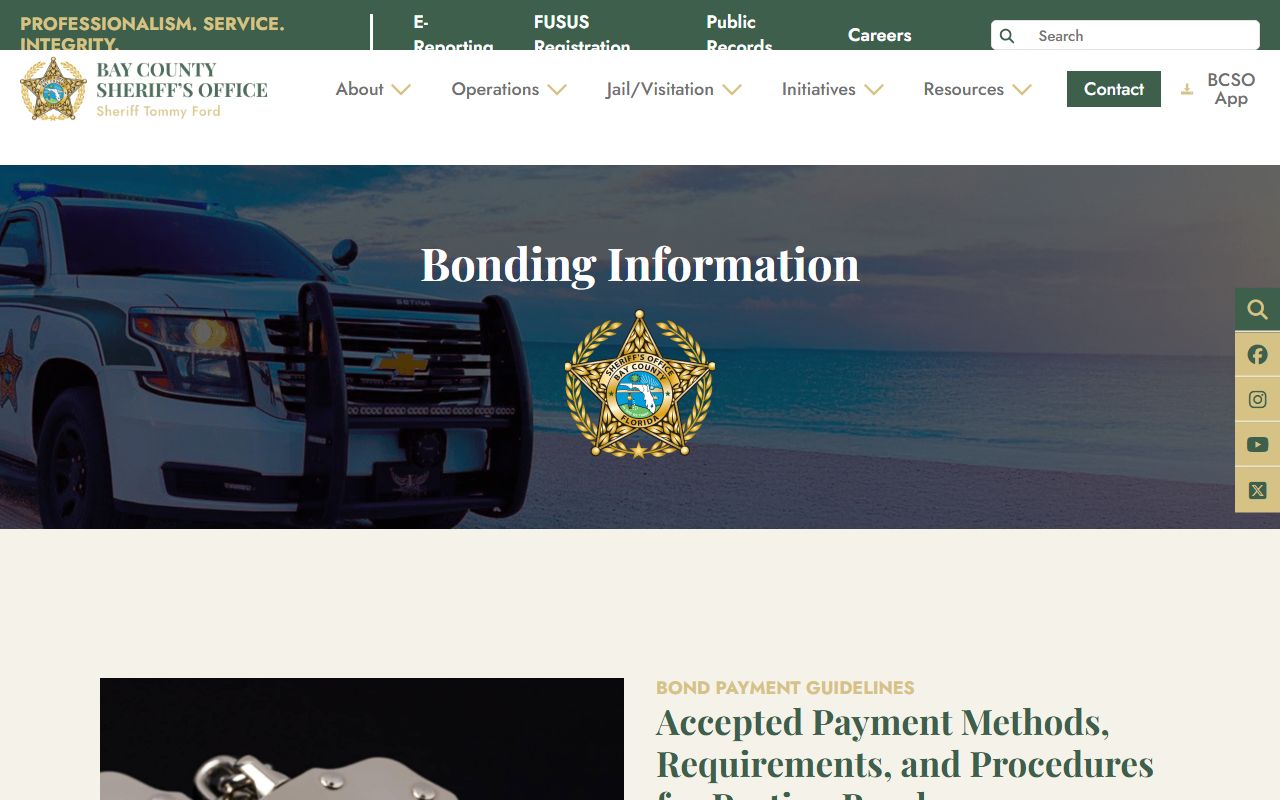
The page also notes that a credit-card bond must be paid in person at the Bay County Warrants Office, where the presenter needs a valid DMV photo ID and the card name must match that ID. The table below sorts out the main bond and release types in Bay County.
| Bond Type | How It Works |
|---|---|
| Cash Bond | Paid with cash at the Warrants Division at the Bay County Jail; bring the exact amount, since the jail cannot make change, and preset bonds are cash or money order only. |
| Surety Bond | Posted through a licensed bail bondsman; the sheriff's office does not recommend an agency, and contact numbers are posted in the Warrants Division lobby. |
| PR / Own Recognizance | A judge may release the person on a written promise to appear at First Appearance, with no money posted. |
| No-Bond Hold | A judge may order no bond; domestic violence battery and all felony cases must attend First Appearance, and outside holds or detainers block release. |
Note: A posted bond on one charge does not guarantee release, because another warrant, court order, or outside-agency detainer can still keep a person in custody.
Warrants That Lead to a Bay County Arrest
Many arrests start with a warrant. The Bay County Sheriff's Office Warrants Division and Fugitive Recovery Unit, commanded by Captain Joe Smiley, handles that work. The division enters all criminal felony warrants into the BCSO records system, the National Crime Information Center, and the Florida Crime Information Center as soon as it receives them from the Bay County Clerk. Clerical staff also mail summons-to-appear notices, and if a defendant does not respond, the unit begins to actively pursue the person. When that arrest happens in Bay County, the person is booked at the Bay County Jail and the case record may show the warrant event.
There is no public warrant-search form on the sheriff site. The image below shows the Bay County Sheriff's Office Warrants page, which explains the process behind an arrest.
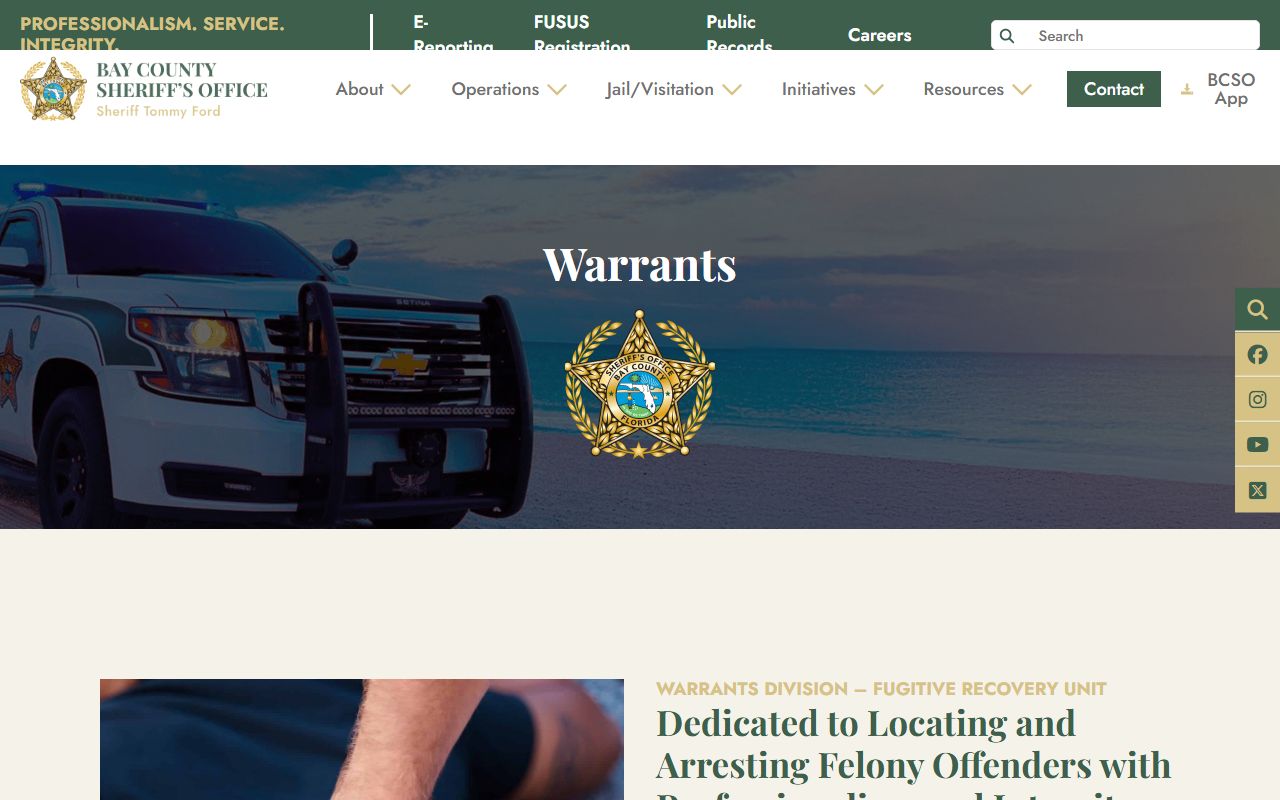
Since no online warrant list exists, a few other channels help. The Clerk case search may show capias, bench-warrant, or failure-to-appear events tied to a case. The sheriff's phone line and a BCSO public-records request are the other routes, though active-investigation rules can limit what is released. Anyone who thinks a warrant may exist should contact the court, the sheriff, or a lawyer rather than simply walk up to the jail counter without legal guidance.
The State Attorney and Charging Decisions
Florida uses State Attorney offices, not county district attorneys. Bay County sits in the 14th Judicial Circuit, and the chief prosecutor is State Attorney Larry Basford. The office represents the people of Florida in criminal cases. Its circuit covers six counties: Bay, Calhoun, Gulf, Holmes, Jackson, and Washington. After an arrest, the office reviews the law-enforcement material and decides what charges to file or pursue, which is why a booking charge and a filed charge are not always the same.
Prosecution-office records are a fallback when the Clerk portal does not hold what you need. Requests go to the State Attorney's official office at PublicRecords@sa14.fl.gov or by phone at (850) 872-4473, extension 1110. Active prosecutions, victim and witness data, and other confidential material are exempt. Federal criminal cases do not appear in the Bay County Clerk portal. The Clerk directs federal court-record questions to the courts in Tallahassee at (850) 521-3501 or in Pensacola at (850) 435-8440.
Charges vs. Convictions in Bay County Records
An arrest and a charge are not a conviction. A charge is an accusation that a case must still prove. A conviction is the result after a verdict or a plea. Both can appear in public court records, so reading a Bay County case file calls for care about which stage a charge has reached.
| Charge | Conviction | |
|---|---|---|
| Stage | Accusation | Verdict or plea |
| Burden of Proof | Probable cause | Beyond reasonable doubt |
| Public Record | Yes | Yes |
Sealed vs. Expunged Arrest Records
An eligible Florida record can be cleared after a dismissal or another qualifying result. A sealed record is hidden from public view but still exists under limited access. An expunged record is treated as though it never happened, with only very limited access left. Court-ordered expunction in Florida runs under Florida Statute 943.0585. The process sets the eligibility rules, the FDLE certificate step, the petition procedure, and the legal effect of an order.
Eligibility is decided through that court and FDLE process, not by a quick online form. The release of criminal-history information sits under Florida Statute 943.053, which controls how the state shares records and protects juvenile data. The table below contrasts the two outcomes.
| Sealed | Expunged | |
|---|---|---|
| Visibility | Hidden from public | Destroyed / treated as never existed |
| Law Enforcement | Limited access | Very limited |
| Eligibility | Set by the court and FDLE process under F.S. 943.0585 | Set by the court and FDLE certificate process under F.S. 943.0585 |
Background Check Considerations
A casual case lookup and a formal background check are not the same thing. Reading a Bay County court file tells you about one case. A formal screening for a job, a loan, or a rental must follow the federal Fair Credit Reporting Act and rely on a licensed consumer reporting agency. Court-portal data can lag behind real case events, so it should not stand in for an FCRA-compliant report.
Important: This resource is not a consumer reporting agency under the FCRA, and its records may not be used to decide credit, employment, housing, insurance, or any other FCRA-covered matter.
Restricted Court Records After an Arrest in Bay County
Not every court record after an arrest is open to the public. Florida public records run under Chapter 119. Florida Statute 119.011 defines public records and confirms that basic arrest facts, such as the name, the time and place of arrest, and the charge, are not treated as confidential investigative material. Florida Statute 119.07 requires a custodian to allow inspection and copying, redact exempt parts, and provide the rest.
Some records stay closed even under that broad access. Juvenile records are restricted and are not searched through the adult system. Sealed and expunged charges drop out of public view. Active-investigation material can be held back while a case is open, and confidential filings are protected. When a record is not online, a public-records request to the Clerk or the State Attorney is the next step, subject to those exemptions and to copy or labor fees.
Note: Juvenile arrest records and active-investigation files are exempt from ordinary public access, so requests for them are routed through restricted channels.